

This enhancement represents a significant step toward the widespread adoption of optical Ethernet in automotive validation, leveraging the tools and software already trusted by OEMs and Tier-1 suppliers.
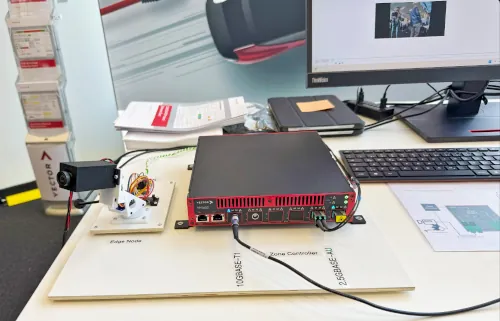
With KD7251 devices installed, the VN5650 retains its robust and modular design, supporting up to 12 automotive Ethernet ports via VNmodule60 slots, while adding nGBASE-AU optical connectivity for link speeds up to 10 Gbit/s (with 2.5/5/10 Gbit/s supported by the KD7251). Users continue to benefit from the VN5650's features, such as synchronous monitoring and fault/load generation, now extended to optical links.
The solution integrates with CANoe's Ethernet option, enabling engineers to program, simulate, and verify Ethernet behavior at scale while assessing 802.3cz compliance in representative vehicle scenarios. The existing VNmodule60 ecosystem remains fully compatible, allowing teams to adapt the physical layers to each test configuration without disrupting established workflows.
“Vector’s adoption of the 802.3cz Optical Ethernet standard in the VN5650 provides development teams with a practical, bench-ready path to validate multi-gigabit links using Vector tools already trusted by the automotive industry,” said Juan Luis Matus, Field Application Engineer Manager at KD. “This is an important milestone in bringing high-bandwidth optical connectivity to automotive applications.”
Matthias Schwedt, Product Manager Ethernet at Vector, added: “Thanks to the seamless collaboration with KD, we have once again demonstrated the exceptional flexibility of our VN5650 interface. As automotive systems demand higher data rates and bandwidth, multi-gigabit Ethernet links will play a critical role in enabling next-generation advanced driver assistance systems (ADAS) and software-defined vehicle (SDV) architectures. With this integration, we are also ready to support multi-gigabit Ethernet optical testing across all scenarios, from complex CANoe-based simulations to basic hardware-level media conversion.”
With KD7251 devices installed, the VN5650 retains its robust and modular design, supporting up to 12 automotive Ethernet ports via VNmodule60 slots, while adding nGBASE-AU optical connectivity for link speeds up to 10 Gbit/s (with 2.5/5/10 Gbit/s supported by the KD7251). Users continue to benefit from the VN5650's features, such as synchronous monitoring and fault/load generation, now extended to optical links.
The solution integrates with CANoe's Ethernet option, enabling engineers to program, simulate, and verify Ethernet behavior at scale while assessing 802.3cz compliance in representative vehicle scenarios. The existing VNmodule60 ecosystem remains fully compatible, allowing teams to adapt the physical layers to each test configuration without disrupting established workflows.
“Vector’s adoption of the 802.3cz Optical Ethernet standard in the VN5650 provides development teams with a practical, bench-ready path to validate multi-gigabit links using Vector tools already trusted by the automotive industry,” said Juan Luis Matus, Field Application Engineer Manager at KD. “This is an important milestone in bringing high-bandwidth optical connectivity to automotive applications.”
Matthias Schwedt, Product Manager Ethernet at Vector, added: “Thanks to the seamless collaboration with KD, we have once again demonstrated the exceptional flexibility of our VN5650 interface. As automotive systems demand higher data rates and bandwidth, multi-gigabit Ethernet links will play a critical role in enabling next-generation advanced driver assistance systems (ADAS) and software-defined vehicle (SDV) architectures. With this integration, we are also ready to support multi-gigabit Ethernet optical testing across all scenarios, from complex CANoe-based simulations to basic hardware-level media conversion.”