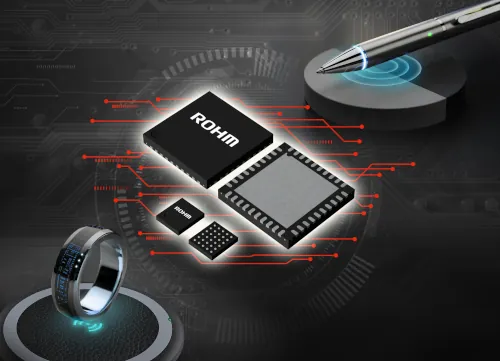
The smart ring market has experienced rapid growth in recent years, particularly in health and fitness applications. However, for these extremely small, ring-shaped devices worn on the finger, wired charging is impractical, while the conventional Qi wireless charging standard is difficult to implement due to limitations such as coil size. This has driven increased demand for a proximity-based power transfer method capable of reliably charging these ultra-compact devices.

In response, NFC-based charging, which operates in the high-frequency 13.56 MHz band enabling antenna miniaturization, is attracting increasing attention, and its adoption is accelerating in next-generation connected personal devices. Following the successful commercialization of the 1 W ML7660 / ML7661 , ROHM has developed the ML7670 / ML7671 chipset optimized for even smaller devices.
This new chipset is based on the proven ML7660 receiver and ML7661 transmitter. Maximum power transfer is specified at 250 mW, and peripheral components, such as the switching MOSFETs required to power the load IC, are already integrated. The result is a solution optimized for both assembly area and power transfer efficiency in the power class demanded by compact connected personal devices, especially smart rings.
The ML7670 power receiver integrated circuit achieves a maximum transfer efficiency of 45% in the low output range of 250 mW, all within an industry-leading form factor of just 2.28 × 2.56 × 0.48 mm. A key feature of the new chipset is its outstanding performance, surpassing the efficiency of comparable products in the same class through optimizations such as coil matching, rectifier circuitry, and reduced switching losses.
Furthermore, all the firmware required for wireless power delivery is integrated directly into the integrated circuit, eliminating the need for a host MCU. This significantly reduces board space and the development workload in device design.
Compliance with the NFC Forum standard (WLC 2.0) enables power transfer while maintaining compatibility with existing devices, positioning the chipset as a central element of the expanding NFC wireless power ecosystem.
The new chipset is now in mass production. It has also been adopted in the SOXAI RING 2, the latest model released on December 10, 2025, by SOXAI, Inc. (“SOXAI” pronounced “SOK-sai”), the Japanese developer and distributor of the original SOXAI RING sleep monitoring ring. Evaluation boards and reference designs are also available to facilitate integration. For more information, please contact a sales representative or submit an inquiry through the contact page on the ROHM website.
In the future, ROHM will continue to promote the development of devices that leverage miniaturization and low power consumption technologies essential for wearable devices, which will contribute to improving user comfort and the continued growth of the connected personal device market.
Specs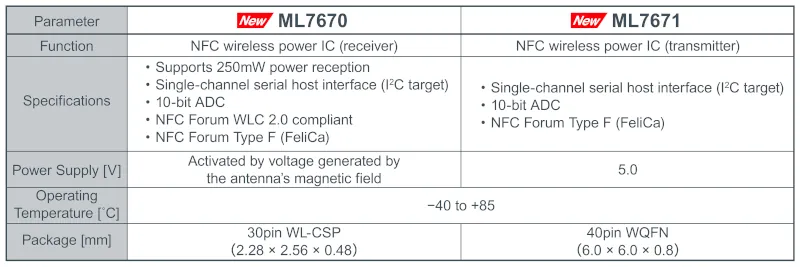
Case Study: SOXAI RING 2 Adoption Example.
The SOXAI RING is the only smart sleep management ring developed in Japan capable of accurately capturing and analyzing sleep data. It incorporates cutting-edge technologies such as an optical vital signs sensor, a temperature sensor, an accelerometer, Bluetooth® Low Energy communication, and NFC wireless charging functionality.
The latest model, the SOXAI RING 2, is equipped with Deep Sensing™, a patented photoplethysmography (PPG) sensor that significantly improves measurement accuracy, allowing for a much deeper and more precise visualization of changes in physical health.

Bluetooth® is a registered trademark of Bluetooth SIG, Inc. in the United States.
Deep Sensing™ is a trademark or registered trademark of SOXAI, Inc.

Application examples
• Smart rings
• Smart bracelets
• Smart pens
• Wireless headphones
• Other compact devices (e.g., wearables)
NFC Forum Terminology International standardization organization for contactless communication that defines methods of communication and wireless power transfer based on near field communication (NFC), a short-range wireless communication technology that operates in the high frequency band of 13.56 MHz.
Qi Standard:
An international standard for wireless power transfer developed by the Wireless Power Consortium. It is commonly used for wirelessly charging smartphones.