
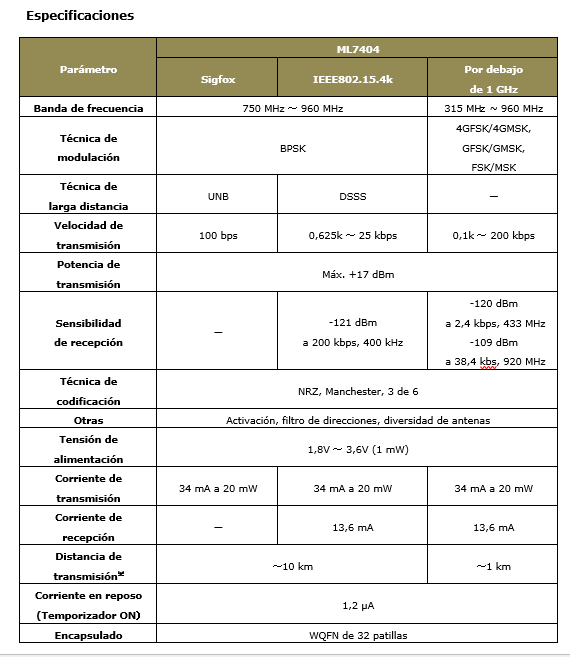
The ML7404 is the first wireless communication LSI on the market to incorporate dual-mode LPWA functionality. It is compatible with the Sigfox standard (a subscription-based LPWA that uses unlicensed bands below 1 GHz), which has been adopted in over 30 countries and is widespread in metropolitan areas of Japan, and with the international IEEE 802.15.4K protocol, characterized by its extreme robustness against self-interference and its ability to cover more terminals on a single network. This dual-mode capability allows its use in a wide variety of applications and
specifications.
The communication modules incorporated into this device will be provided by partner companies to simplify the development of LPWA-compliant devices that contribute to increased IoT adoption. Furthermore, the protocol stack for IEEE 802.15.4k will be supplied as open source through our distributors.
 Over the past few years, LPWA, which uses the sub-1 GHz band (which does not require RF licenses), has been attracting attention for IoT applications. However, the communication protocol varies between countries and regions because a standardized technique for the diverse IoT networks has not yet been established.
LAPIS Semiconductor had previously announced other low-power wireless communication LSIs for sub-1 GHz radio base stations, outperforming its competitors, with the aim of creating a smarter world through IoT. This time, we have developed a multi-technique LPWA device that facilitates the launch of IoT networks and the effective deployment of applications and services.
Main Features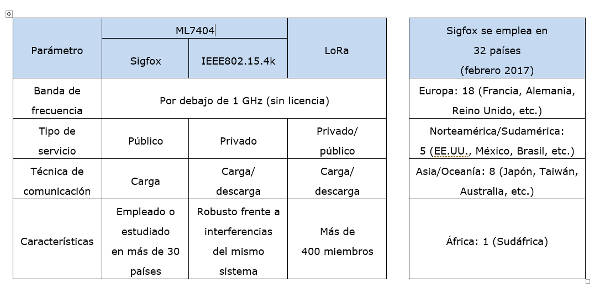 1. Dual-Mode LPWA Compatible (Sigfox and IEEE 802.15.4k)
The ML7404 is a dual-mode LPWA wireless communication LSI compatible with the IEEE 802.15.4k and Sigfox standards, the most widely used in Europe.
a) Sigfox Compatible
Sigfox is a type of LPWA wireless communication system currently used in more than 30 countries worldwide.
b) IEEE 802.15.4k Compatible
The IEEE 802.15.4k standard is characterized by DSSS based on orthogonal scattering codes and its high tolerance to interference from the same system compared to other spread spectrum communication techniques. It can also support more terminals on the same network. This protocol uses the highly reliable, unlicensed sub-1 GHz band.
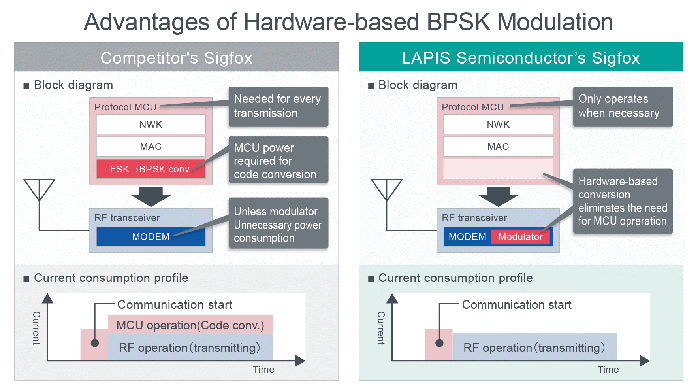 2. The first hardware-based BPSK modulation circuit on the market for Sigfox helps reduce power consumption.
Sigfox employs the BPSK modulation technique, which is not used in conventional communication below 1 GHz. However, because Sigfox-compatible LSIs do not support BPSK modulation, it is necessary to generate BPSK symbol data using software in the control microcontroller. This requires activating the control microcontroller every time wireless communication occurs, unnecessarily increasing power consumption. In contrast, the ML7404 integrates a BPSK modulation circuit that eliminates the need for the control microcontroller to operate (at the physical layer) during wireless communication, thus reducing system power consumption.
 3. Development Support:
An optional evaluation kit combines sample programs (simple MAC) and various test scenarios, and reference module designs are currently being prepared. Comprehensive support, including manuals and tools, is also available for download from the LAPIS website (registration required). In the future, partner companies will introduce communication modules integrating the ML7404 and low-power protocol stacks for IEEE 802.15.4k.
Sales program
- Reference: ML7404
- Sample availability: July 2017
- Mass production: December 2017
- Packaging: tape and reel (1,000 units/reel)
Recommended applications:
Gas and water meters, sensor networks, building condition monitoring, smart agriculture, security systems, and other industrial applications that require long-distance wireless communication.
Terminology
: A long-range wireless protocol that is part of the IEEE family of standards. Sensitivity is improved using the Direct Sequence Spread Spectrum (DSSS) technique. The IEEE 802 series standardizes physical layers such as wireless LAN, Bluetooth, ZigBee, and Wi-SUN.
DSSS (Direct Sequence Spread Spectrum): A type of spread spectrum technique that distributes and transmits baseband signals within a wider bandwidth. Pseudo-noise is distributed by frequency and regrouped during reception, thus providing much greater robustness against interference.