
Often, the purpose of a transformer is unclear, leading to confusion and increasing the risk of incorrect technical decisions. Below, we outline and illustrate some key factors for choosing the right solution.
Transformer-Based UPSs:
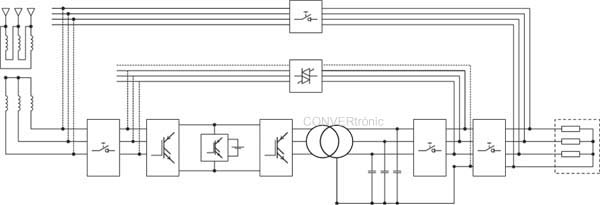
A common misconception is that transformer-based static UPSs guarantee overall galvanic isolation.
As shown in Figure 1, this isolation is only guaranteed when operating from an inverter.
If the bypass line is not isolated, complete isolation between the input and output is not guaranteed. If such isolation is required, an additional transformer is needed in the bypass line.
In reality, the transformer in this type of equipment is used to reconstruct the waveform of the sine wave generated by the inverter, adapting it to the value of the output voltage.
 When Does a UPS Need a Transformer?
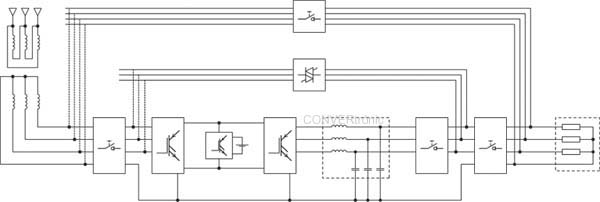
Generally speaking, a UPS does not need a transformer. A transformerless UPS requires a neutral to operate. This design is related to several factors, such as reduced space requirements, lower costs, and achieving maximum efficiency.
However, there are cases where a transformer is required in this type of UPS:
To create a neutral when one is not available in the installation.
If the UPS is powered by separate inputs, to avoid combining two completely different neutrals (see Figure 2), for example, if the power supplies come from two different transformer substations.
When galvanic isolation is required or when a neutral configuration change is needed.
In conclusion,
there is no general rule for choosing between transformerless and transformer-based UPS technology. This choice is determined by technical and economic factors related to the desired level of safety for the installation, as well as the associated costs.
The best course of action is to contact the UPS manufacturer to
determine the most suitable solution for your low-voltage electrical installation.
Author:
Socomec UPS